Anabolic resistance after 50: what the 2026 meta-analysis found
Anabolic resistance after 50 may blunt how older muscle responds to protein, but a 2026 meta-analysis suggests exercise still works.
What is anabolic resistance, and why does it seem to matter after 50, when recovery slows or a week off training takes longer to reverse? A 2026 meta-analysis by Kristiansen and colleagues in Frontiers in Physiology gives a measured answer. Older muscle appears to produce a weaker muscle protein synthesis response at rest and after protein intake than younger muscle. It does not become untrainable.
Muscle protein synthesis, or MPS, is the process of building new muscle proteins after food or exercise. Anabolic resistance describes a blunted version of that response. In the review, pooled data from 46 studies and 1,280 participants showed lower fasting, or post-absorptive, MPS in older adults and a lower post-prandial response after protein. The post-exercise response looked much closer to preserved.
That split matters. The question is not whether older adults can build muscle at all. It is which inputs still work, and how deliberate they need to be once the margin for error shrinks.
What the 2026 meta-analysis actually found
The Kristiansen et al. paper was an integrative review, not a single lab experiment. It combined acute tracer studies that measured how quickly muscle built protein under different conditions in younger and older adults. Across the pooled dataset, older adults had significantly lower resting MPS and a lower post-prandial response. The effect sizes, reported as standardised mean differences of -0.167 at rest and -0.348 after feeding, do not support claims that people simply “stop absorbing protein after 50.” They point to a real but modest age gap.
“Post-absorptive MPS was significantly lower in older compared with younger adults.”
Kristiansen et al., Frontiers in Physiology (2026)
The exercise data were more reassuring. In studies that measured MPS after exercise, the gap between younger and older adults was less convincing. The authors argue that exercise appears to preserve more anabolic potential than protein alone. Ageing still matters, but the practical takeaway moves away from fatalism and back toward training.
“Preserved MPS response to exercise suggests maintained anabolic potential when appropriate stimuli are provided.”
Kristiansen et al., Frontiers in Physiology (2026)
Limits remain. Most included studies were short-term metabolic experiments, not multi-year trials tracking falls, strength or independence. The paper compares age groups. It does not prove that a switch flips at exactly 50.
Why older muscle can look less responsive
A 2025 review by Pérez-Castillo and colleagues in Nutrients defines anabolic resistance as a diminished ability of ageing muscle to respond to anabolic stimuli such as protein intake and exercise. Put plainly, the same meal or training session may produce a smaller biochemical signal in an older body. That helps explain why muscle mass becomes harder to hold onto with age, especially when illness, lower activity or under-eating pile on.
“Anabolic resistance, consisting of a diminished ability of aging muscle to respond to anabolic stimuli such as exercise and protein intake.”
Pérez-Castillo et al., Nutrients (2025)
Researchers do not pin the change on one mechanism. The review points to lower habitual activity, more sedentary time, altered digestion and amino acid handling, inflammation, and a muscle environment that may need a stronger stimulus before it adapts. Useful concept, easy to oversell.
Anabolic resistance is not the same as saying protein no longer matters, or that muscle loss is inevitable after midlife. It is closer to a volume knob than an on-off switch. Older muscle may need clearer signals: enough total protein, spread sensibly through the day, plus resistance training that is hard enough to ask for adaptation.
Why exercise still looks like the strongest lever
If the meta-analysis has one encouraging message, it is that exercise keeps more leverage than protein alone. Mechanical tension, the force a contracting muscle produces against a load, still speaks loudly to muscle tissue in later life.
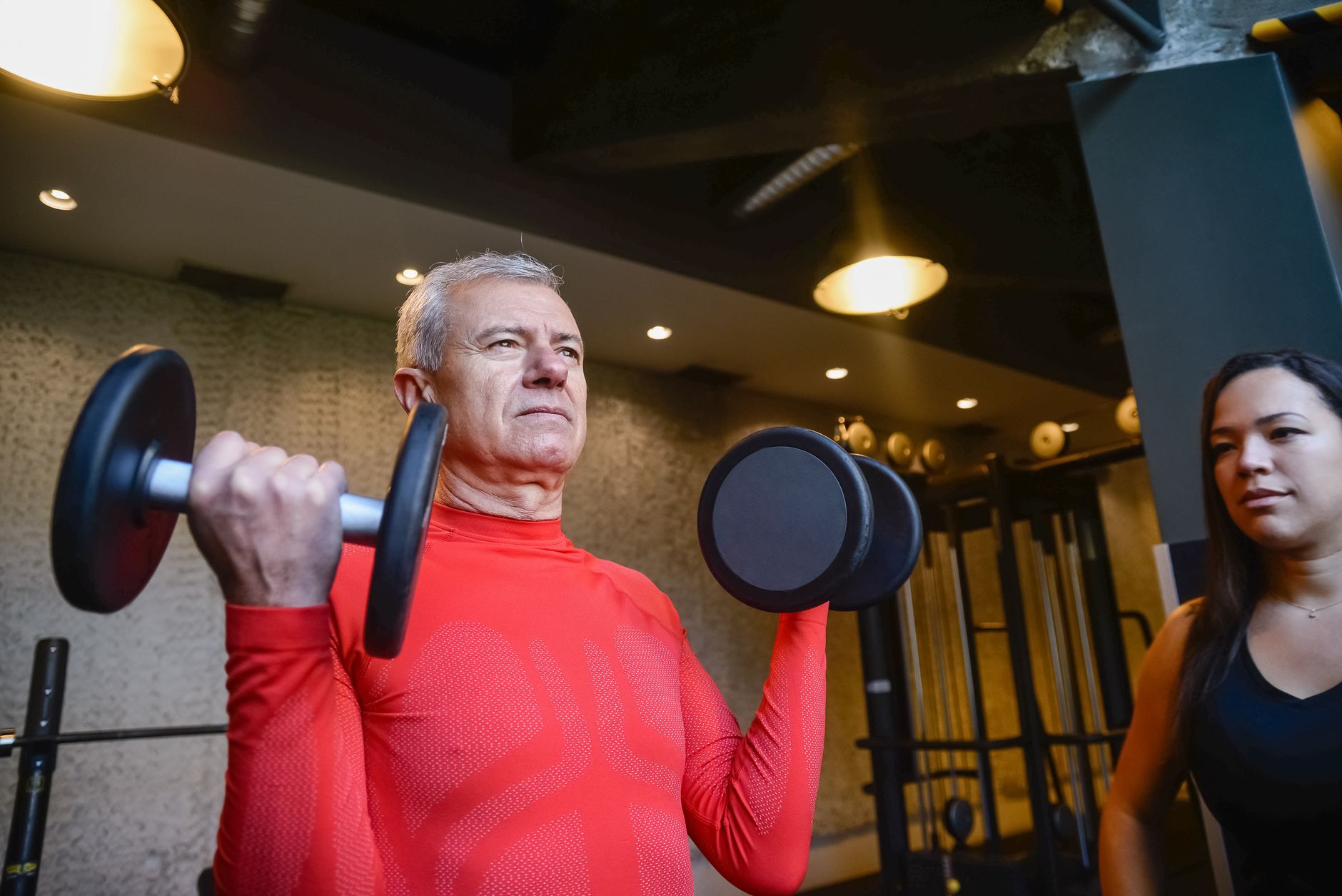
The 2026 trial indexed in Experimental Gerontology is useful context. In that 16-week study, 103 healthy older adults completed high-load resistance training, with creatine or placebo, while researchers tracked physical function, cognition, inflammation, oxidative stress and quality of life. It was not a clean test of whether creatine reverses anabolic resistance by itself. Read more narrowly, it reinforces a grounded point: older adults can still adapt when training is substantial enough to demand adaptation.
A barbell, cable stack or machine sends a blunt message to muscle tissue. Use this tissue. That does not cancel age-related biology, but it helps explain why the exercise response in the meta-analysis held up better than the feeding response alone.
What to do with this information after 50
The useful response is plain. Eat enough protein across the day. Keep training. Do not expect one supplement to do the work of either. A 2025 practice review by Harris, DePalma and Barkoukis in Nutrients argues that many older adults underconsume protein and suggests about 1.0 to 1.2 g/kg/day for healthy older adults, with roughly 25 to 30 g per meal as a practical distribution target. Those are population targets, not personal prescriptions. Anyone with kidney disease, frailty or multiple medical conditions should talk to a clinician before making major diet changes or starting any supplement.

That is why the “best protein” debate can distract. If someone is missing meals, avoiding strength work, or eating most protein at dinner and very little earlier in the day, consistency may matter more than powder choice. Creatine may be worth discussing with a clinician in the context of resistance training, but the 2026 trial does not make it a workaround for muscle ageing. Even mindbodygreen’s recent 235-trial overview of protecting muscle with age lands near the same point: daily habits matter more than one product claim.
Younger adults can often get away with scattered meals and inconsistent training and still rebound. Older adults usually have less slack. That is less glamorous than a supplement pitch, but closer to the evidence.
What to watch next
The next research question is harder than whether an acute tracer signal moves. Longer trials need to connect MPS responses to outcomes people can feel: strength, falls, walking speed, recovery and independence. It would also help to see more studies in adults closer to 50, not just older cohorts, and more head-to-head work on protein distribution, resistance training and creatine in the same design.
For now, the 2026 meta-analysis sharpens the message rather than overturning it. Anabolic resistance appears to be real. It is not a verdict. After 50, muscle may be less easily persuaded. The current evidence suggests it still responds best to the same fundamentals, just with less room for guesswork.
References
- Kristiansen JB, Vissing K, Nielsen JL. Age-related anabolic resistance and post-absorptive muscle protein synthesis: integrative evidence from a systematic review and meta-analysis. Frontiers in Physiology. 2026. https://www.frontiersin.org/journals/physiology/articles/10.3389/fphys.2026.1740284/full
- Pérez-Castillo ÍM, Rueda R, Pereira SL, et al. Age-Related Anabolic Resistance: Nutritional and Exercise Strategies, and Potential Relevance to Life-Long Exercisers. Nutrients. 2025. https://pmc.ncbi.nlm.nih.gov/articles/PMC12655298/
- Harris S, DePalma J, Barkoukis H. Protein and Aging: Practicalities and Practice. Nutrients. 2025. https://pmc.ncbi.nlm.nih.gov/articles/PMC12348035/
- Fernandez-Garrido J, Martin EG, Saez-Berlanga A, et al. Effects of high-load, velocity-intentional variable resistance training combined with creatine supplementation on neuroplasticity, oxidative stress, inflammation, physical function, cognitive performance and quality of life in healthy older adults. Experimental Gerontology. 2026. https://pubmed.ncbi.nlm.nih.gov/41941966/
The Vitalspell brief
Evidence-based supplement science — weekly in your inbox.
Subscribe